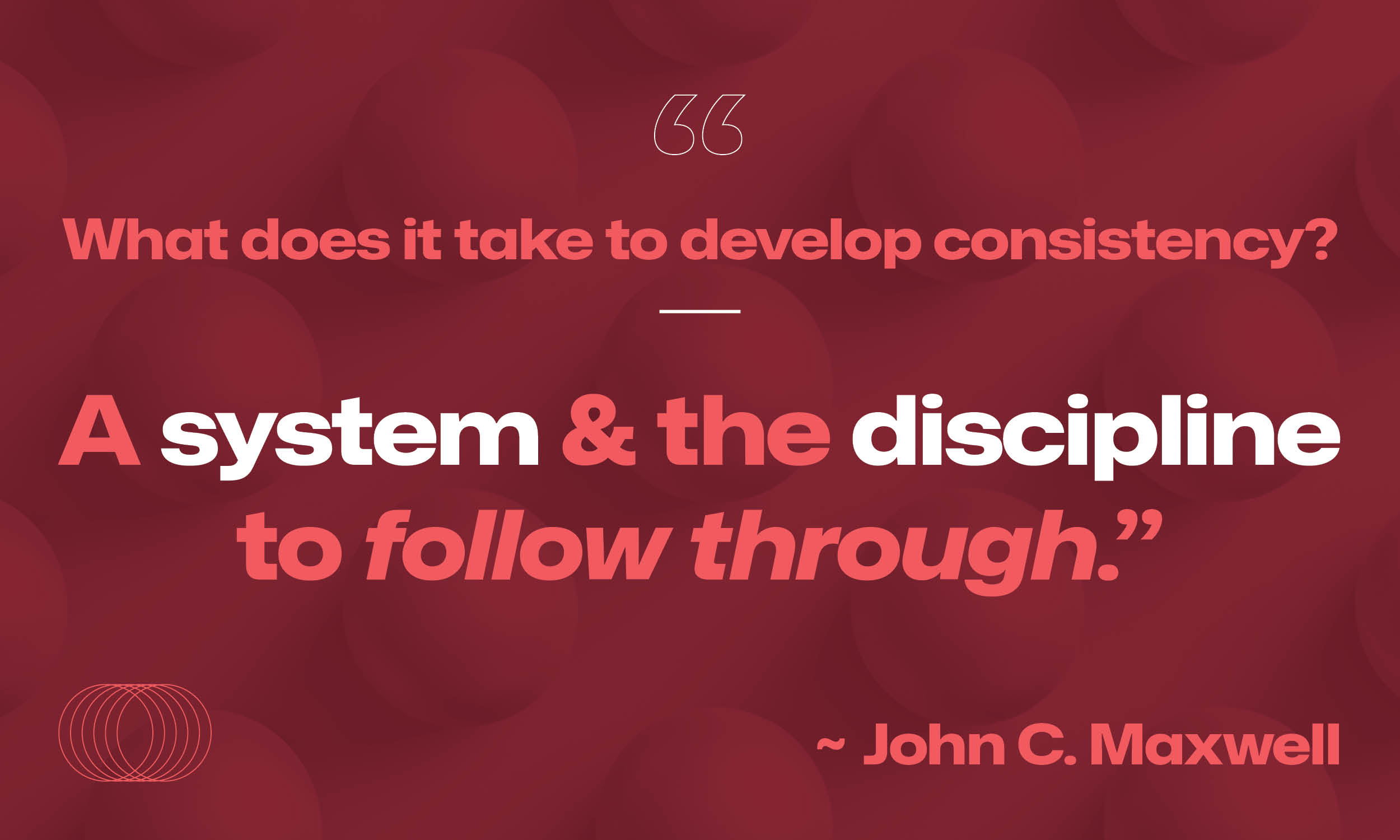
“What does it take to develop consistency? A system and the discipline to follow through.” These are wise words from John C. Maxwell, and the sentiment hits hard when it comes to consistency in marketing.
You’ve seemingly tried it all, but nothing’s working. You had a few perfectly crafted social posts that did numbers on their respective platforms. You cranked out a valuable blog that helped to drive web traffic. Somehow, though, meaningful results never seemed to follow. Leads just didn’t come in, and those that did failed to convert. Through it all, you’re left wondering: Why is my marketing not working?
Sometimes we have to have difficult conversations, and this blog is, in a way, one of those conversations. So let’s tear the band-aid off and come out with it: The problem is your consistency in marketing (or the lack thereof).
“Why Is My Marketing Not Working?”
Small- to medium-sized businesses often face a similar pattern. Time and money are invested into marketing, and when the results are less than ideal, efforts are pulled back. Some time later, a new bold idea is put into action, only to lead to the same outcome. Rinse. Repeat.
It can be frustrating, for sure. The world of marketing can be unpredictable, but that doesn’t mean these frustrating outcomes are all based on bad luck. But the frustration is still understandable. You work hard and put a lot of effort into your business. You need this to work. But here’s the tough pill for some to swallow: Many marketing efforts aren’t given enough time or continuity to work at all. The soil is there, but the plant is uprooted before it can take hold. The root cause is inconsistency.
The “Start and Stop” Marketing Cycle
Think back to the last time you were truly swamped. Was it a busy season? A big project? Chances are your team was stretched thin, and what was the first thing you put on the back burner?
Marketing. Almost always marketing.
This is a common start-stop cycle and it can cripple the efforts of the most well-intentioned small or medium business. The process goes:
- Business is dragging → You run a campaign and push out punchy content
- Business picks up → You put your marketing efforts aside
- Business once again slows → You find yourself needing to start from scratch
You aren’t just pausing every time this process repeats; you’re losing ground, potentially while your competition is gaining it. All that momentum you’ve built, gone. The audience you attracted had no reason to stick around, so they left.
This “deadly” cycle undermines the progress you’ve worked so hard to make.
Being Consistent Matters More Than Being Perfect
Do you want a one-hit-wonder or continued growth and success? We’re willing to bet you prefer the latter, so consider this: A good message delivered consistently will, in the long-term, outperform a one-time, brilliant message.
Consistency in marketing builds familiarity. That familiarity turns strangers into prospects, prospects into customers, and customers into loyal fans who keep showing up. It’s not magic. It’s brand recognition. It’s repetition. In fact, there’s research that shows that five to seven impressions are needed in order to get a consumer to recognize a brand. So that one-hit wonder? It’ll be forgotten pretty quickly. A single campaign or a single month of solid posts won’t get you there. Showing up over and over in the right places will.
Here are some stats to consider:
- Consistent brand presentation can increase revenue by 23–33%, according to data from Lucidpress.
- 68% of companies say brand consistency contributed at least 10% to their revenue growth.
- 79% of consumers are more loyal to brands that maintain consistent communication across all channels.
Despite all this, only a small percentage of B2B companies say their branding is consistent.
The Long-Term Nature of Effective Marketing
We live within a culture of instant gratification, but some of the best things in life require long-term nurturing. If you expect your marketing to deliver leads right out of the gate, you’re in for some disappointment. We aren’t being pessimistic. We’re being realistic. The good news is there’s a solution!
Think of marketing as cumulative. One blog post isn’t going to bring undeniable success your way, but it will play its own small part in the bigger picture. If you don’t want that small part to be wasted, you need to follow the post up with another, and another, and another. Every social post, digital ad, and email is a small deposit into an account. The balance will only grow slowly at first, but you will see the light once it starts to compound. Let’s look at how that plays out across some common channels.
SEO & Content
Search engines love consistency. A website that publishes quality content on a regular basis slowly builds its authority over time, which leads to an increase in organic traffic. One great article simply won’t cut it. A steady stream of good content? Now that’s something Google can fall in love with.
Social Media
Similarly, the all-powerful social media algorithms favor accounts that post regularly. Past that, it’s helpful to get your name in front of your audience without prolonged periods of absence. If you post sporadically, you make your brand easy to forget.
Email Marketing
Email has the potential to be a high-ROI channel for you, but only if you use it regularly. An email list you ignore for a long time is a cold list, and a cold list isn’t good for conversions.
Digital Advertising
Just because you’re putting money into it doesn’t mean you can get lazy with it. Digital campaigns that run for prolonged periods can gather data, optimize over time, and become more efficient when they’re nurtured. If you cut them off before they hit their stride, you’re crippling your chances at success in your paid campaigns.
The businesses that get the most out of their marketing strategy development aren’t necessarily the ones with huge budgets. They’re the ones who have a long-term plan and stick to it, even with a limited budget.
Common Barriers to Consistency in Marketing
Wondering why so many businesses fail to remain consistent? Unfortunately, knowing the problem is only a part of the battle. Say you’re a business owner who’s well aware that sales could be better. What’s stopping you from stepping it up? While there are plenty of possible reasons, there are a few we’ve noticed again and again across the board.
- No clear plan: Many businesses have their daily routine down pat. They know how to make their existing products look pretty. They can deliver a mean elevator pitch. But without a content calendar or defined schedule, all that skill and knowledge goes into reactive marketing, or “random acts of marketing.” Posts only happen when they pop into your head, and ads are only run when you’re desperate for sales. That’s an approach that’s more of a gamble than a strategy.
- Limited time and resources: This one’s real. This one’s understandable. If you’re a small business owner, you’re wearing eight different hats at any given moment. A ninth may make it all come crashing down. This is where marketing strategy development matters. Once you have a system in place that doesn’t require you to bend over backwards to maintain it, things get better. Getting there is the hard part.
- Unrealistic expectations: We said earlier that we live in a culture of instant gratification, and a downside of that becomes apparent here. When results don’t appear immediately, it’s tempting to conclude the effort isn’t worth it. But abandoning a marketing effort too early is like turning the lights on before a picture is fully developed: You’ll never see the end result.
Step one is recognizing these barriers. After that, you need to build a system that accounts for them. If you don’t have the manpower, we know some people who can do the heavy lifting for you (spoiler: It’s us).
Building a Marketing Habit
Reaching consistency in marketing doesn’t require a massive overhaul. Just a plan you can realistically stick to. Here’s how you might achieve that goal:
Start With Realistic Goals
Two posts a week for an indefinite amount of time is a much better strategy than posting twelve times in a week and then going radio silent. Determine what your realistic capacity is and go from there.
Choose Your Channels With Intention
You don’t need to be everywhere. An ice cream shop doesn’t need to publish whimsical vibe posts on LinkedIn, and an accounting firm probably doesn’t need to be posting on Snapchat. Choose two or three platforms you can reliably be on. The ones your customers are already on! Once you reach your stride on those platforms, then you can think about expanding. If you’re unsure of the platforms your business should be on, we can help you out.
Use a Content Calendar
We can’t stress enough how many times a content calendar has saved our hides. Considering the breadth of services we offer, we have a bunch of projects going on at any given time. Keeping everything organized in our heads would be impossible. A simple calendar maps out a publishing plan and takes the messy guesswork out of achieving consistency in marketing. No need for the calendar to be complicated, but it does need to exist. As our Social Media Manager, Maddy McClellan puts it, “Content calendars are the crucial first step to content creation. They allow us to plan, review old content, link to external articles, and seek approval from account managers before designing content.”
Treat Marketing as a Function, Not a Project
While projects have end dates, marketing as a whole doesn’t. It goes on, only stopping when consistency does. If you’re thinking of it as something to be finished, you’re viewing it through the wrong lens. It needs to be built into your operations like sales, accounting, or customer service. If sales are the electricity of a successful business, marketing is the running water. You’re going to struggle when you run out.
Get Leadership Involved
If your leadership team doesn’t buy into your marketing plan, you can lose steam (I said that with leadership’s approval). If your marketing isn’t working despite attempts to stay consistent, ask yourself if the people at the top are buying into it.
Consistency: The Real Competitive Advantage
Outmarketing your competition doesn’t happen through having a bigger budget. It happens through discipline. Discipline to show up regularly for your audience in inboxes, search results, and feeds. Consistency in marketing keeps you in the conversation and sparks the recognition you need to turn prospects into sales. Success isn’t instant, but the wait is worth it if you stick with it.
At the same time, you can only stretch your resources so far. You may find yourself unable to keep up with that key consistency if you only have so many people on your team. That’s where ArachnidWorks comes in. We do the heavy lifting for you, starting with marketing strategy development. From there, we keep up the content and conversation with your audiences while keeping you in the loop. There’s a gap between intention and outcome, and that gap is where we can be the most help to you.
Random acts of marketing end here. Get in touch and we’ll help you develop and maintain consistency in your marketing.