If you’ve ever lost a deal to a bigger competitor and immediately thought “if only we had their budget,” you’re not alone. It’s the most natural conclusion in the world. They have a slicker website, more ads running, a bigger team, and a brand that everyone recognizes. You connect a few dots and decide money is the main difference-maker.
But budget isn’t always the culprit. For most small businesses trying to figure out how to compete with larger companies, the real problem is something different (and fixable). Marketing for a small business doesn’t fail because of what you can’t spend; it fails because your spending isn’t connected. This isn’t a piece about cheap tricks or doing more with less. It’s about understanding the real reason you’re losing, and what a successful SMB marketing strategy looks like.
The Budget Gap Is Real, But It’s Not the Whole Story
We’re not pretending the gap doesn’t exist. Any honest conversation about how to compete with larger companies has to start here: They can outspend you on ads, buy more placements, and staff entire departments just to produce content. That’s true, and minimizing it doesn’t help anyone.
But that budget often funds complete chaos.
A lot of enterprise marketing organizations are running SEO through one vendor, paid media through another, social through a third, and content through a fourth. There’s no single person responsible for making sure any of it connects. Different agencies, messages, and metrics, with nobody talking to the same customer in the same voice. Through it all, someone in a boardroom is trying to figure out why the awareness numbers aren’t reaching expectations.
You’re not competing against a well-oiled machine. More often than not, you’re competing against a bigger version of your own problem…just with more money behind it.
The Real Problem Is Fragmentation, Not Budget
So what is the diagnosis? Random acts of marketing.
This is what it looks like in practice:
- Your website says one thing while your sales pitch says another.
- Your ads are running a promotion that nobody on your team can explain the strategy behind.
- Your last three blog posts have nothing to do with the customers you’re trying to reach.
- Every channel has a different message, tone, and idea of who you’re talking to.
None of your content is wrong or misleading; it just lacks a connecting thread. And disconnected marketing for a small business can actively work against you. When a prospect encounters your brand in three different places and gets three different impressions, the result is confusion. And confused prospects don’t buy.
This is where the concept of an SMB marketing strategy becomes more than a buzzword. A strategy isn’t a list of channels you’re active on; it’s the connective tissue between all of them that lets your audience know the messaging is coming from the same company.
More activity without that connection is just an accelerant to the issue.
Your Constraints Are an Advantage If You Use Them Right
A larger competitor with a bloated marketing budget can run ten campaigns simultaneously and call it a strategy. You don’t have that luxury, which means you have to figure out what actually moves the needle and commit to it. That discipline is uncomfortable, but it produces better decisions than an unlimited budget that allows you to avoid hard choices indefinitely.
There’s also the agility factor, a crucial aspect of any SMB marketing strategy. When a market shift, such as a competitor mistake or emerging search trend happens, you can react much quicker than big enterprises; it seems like lightspeed in comparison. A large competitor needs approvals, brand reviews, legal sign-off, and a committee meeting (hence why so many big brands are slightly late to the latest viral meme trend). You just need to consider it in your head and say, “Let’s do it.”
And then there’s the founder or owner advantage. When the person who built the business shows up in a conversation, writes a piece of content, or responds to a customer directly, it carries a weight that content produced by a marketing department three levels removed from the customer never will.
Don’t let this become a pep talk, though. The point isn’t to feel better about your constraints. The point is to use them with purpose. When it comes to how to compete with larger companies, discipline beats budget more often than most people expect.
The Shift From Tactic Collection to Marketing System
This is where things get practical.
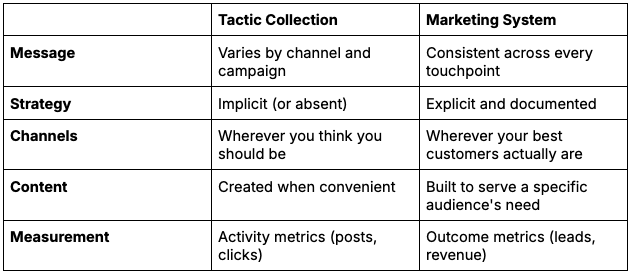
A marketing system is not complicated to define, but it’s harder to build than it sounds. Here’s what it actually means: one clear message, expressed consistently across every channel, connected to a specific audience with specific needs, and measured against outcomes that matter.
Here’s a breakdown of the difference:
In practice, a system looks like this:
- Your positioning drives your SEO keyword selection.
- Your SEO keyword selection informs your paid ads strategy.
- Your paid ads strategy connects to your organic social media content.
- Your social media speak the same language as your sales conversations.
A prospect who finds you through Google, follows your company on LinkedIn, and then gets on a call with your team should feel like they already know what you’re about because every touchpoint they came across told the same story.
Building this doesn’t require a massive team or a bottomless budget. It requires a decision about who you serve, what you stand for, and what you want prospects to believe before they talk to you. Most businesses skip the decision and go straight to the tactics. That’s where the random acts start.
Where Small Businesses Actually Win: Choosing the Right Competitive Surface
You can’t beat a larger competitor everywhere, but you don’t need to. The most practical answer to how to compete with larger companies is to identify where you have a structural advantage and win there.
Long-tail search. Big brands chase broad, high-volume terms because they have the domain authority and the budget. The specific, intent-driven searches that describe your exact customer are often underserved. An effective SMB marketing strategy involves owning those specific corners of search. Less competition, higher intent, more relevant traffic.
Niche authority. There’s a meaningful difference between being a decent option for many people and being the obvious choice for a specific type of customer. A company searching for a marketing partner doesn’t want a generalist. They want someone who understands their world. The more specifically you can speak to a defined audience, the harder it is for a bigger, broader competitor to dethrone you.
Relationship depth. Customer retention is dramatically cheaper than acquisition. An SMB marketing strategy that treats existing customers as a growth channel turns loyalty into referrals and repeat business that no ad budget can replicate. The relationship advantage is real, but only if you pay attention to it.
Speed. When conditions change, you move. A large competitor schedules a meeting to talk about scheduling a meeting. This is not an exaggeration, and it’s something you can use to your advantage by flexing your agile muscles.
The goal isn’t to compete everywhere; it’s to identify where you have a structural advantage and win there.
A Starting Framework for Action
Before you spend another dollar on marketing, answer these three questions honestly:
1. Who is your best customer and what do they need to believe before they buy from you?
Don’t say “small business owners” or “companies in manufacturing.” Those descriptors are too broad. You need to define the specific person, with specific concerns, who becomes a great client. What do they need to understand about you before they’re ready to have a real conversation?
2. Which one or two channels do your best customers actually use? Are you showing up there consistently?
The most successful small businesses don’t decide what channels they need to be on. Their customers do. It’s where they find information, evaluate options, and make decisions. Be there reliably (and bring something worth their time).
3. Does your marketing tell the same story across every touchpoint?
Pull up your website, last three social posts, most recent ad, and standard sales pitch. Do they feel like they come from the same company? If a prospect encountered all four, would they get a coherent picture or a confusing one?
These are the marketing tips for small businesses that matter before any others. Answer these questions before you worry about tactics. Most businesses reverse the order and spend years wondering why nothing lands. If you want to know how to market your small business effectively, this is where it starts.
The Gap Is Closeable, But Not the Way You Think
The distance between you and a larger competitor isn’t primarily a money gap; it’s a systems gap, and systems are buildable. That’s the real answer to how to compete with larger companies. It’s not a bigger budget, but a better-connected one.
You don’t need to outspend them. You need to out-think them. That’s what makes marketing work. Not volume or budget, but coherence.
If you’re an established SMB and this is the problem you’re dealing with, this is exactly the kind of thing we work on at ArachnidWorks. We’re happy to help you connect all the dots.